
Driveways & Walkways August 30, 2026
How Heated Driveways Work in Minnesota Winters
How a heated driveway works, what decides the running cost, what it does not solve, and why the decision has to be made before the surface goes down.
A heated driveway in Minnesota is one of those upgrades that sounds like an indulgence until the third February in a row of clearing the same slope at six in the morning. It is also widely misunderstood — what it does, what it costs to run, and what it does not solve.
Here is the mechanism, plainly, and where it earns its place.
How the system works
A heated driveway is a snow-melt system installed within the build-up beneath the surface, not on top of it. Two approaches are common.
Hydronic systems circulate a heated fluid — usually a glycol mix — through tubing laid under the surface, driven by a boiler. Electric systems run resistance cable or mats through the same layer and heat directly from the supply.
Hydronic generally costs more to install and less to run, and it suits larger areas. Electric is simpler to install, needs no boiler, and suits smaller areas and walkways. Which is right depends on area, on what heat source the house already has, and on what the electrical panel can carry.
Either way, the system is part of the build-up. It goes in before the surface does.
Controls decide the running cost
This is the part that gets skipped, and it matters more than the heating technology.
A system on a manual switch runs when someone remembers to switch it on, which means either running when it does not need to or being switched on too late to be useful. A system on a snow sensor and a slab thermostat runs when there is precipitation and the surface is near freezing, and stops when there is not.
Zoning matters too. Heating the whole driveway when the problem is the slope near the garage and the walk to the front door is most of the running cost for none of the benefit.
What it costs to run
We are not going to publish a figure, because a number without the variables behind it is worse than no number at all. Running cost depends on the heated area, the system type, how it is zoned, how it is controlled, your utility rate, and how hard the winter is.
What we can say is the shape of it: cost scales with area and with how long the system runs, and both of those are things you decide at design stage. A well-zoned, sensor-controlled system heating the parts that matter costs a fraction of an unzoned one on a manual switch.
What it does not solve
It clears the driveway. It does not clear what the plow leaves at the end of it — the ridge of compacted snow deposited across the apron by a passing plow is denser and deeper than anything falling from the sky, and a snow-melt system will take a long time to deal with it, if at all.
It does not replace the shovel entirely. Steps, the far end of a walk and anywhere outside the heated zone still need clearing.
And it is not a retrofit. Heat cannot be added under an existing surface without taking that surface up, which means the decision belongs at design stage or it belongs to the next driveway.
What it does solve
A sloped driveway that ices, which is a genuine safety problem rather than an inconvenience. A long walk to the front door. A household where someone should not be out clearing snow. And it removes the main reason people reach for de-icing salt, which is worth more than it sounds — chloride attacks concrete, particularly concrete that has not fully cured, and salt damage to a surface cannot be undone.
The surface above it
A snow-melt system can go under a conventional concrete slab, under pavers, or under a resin-bound surface. The choice of surface is largely independent of the heating decision.
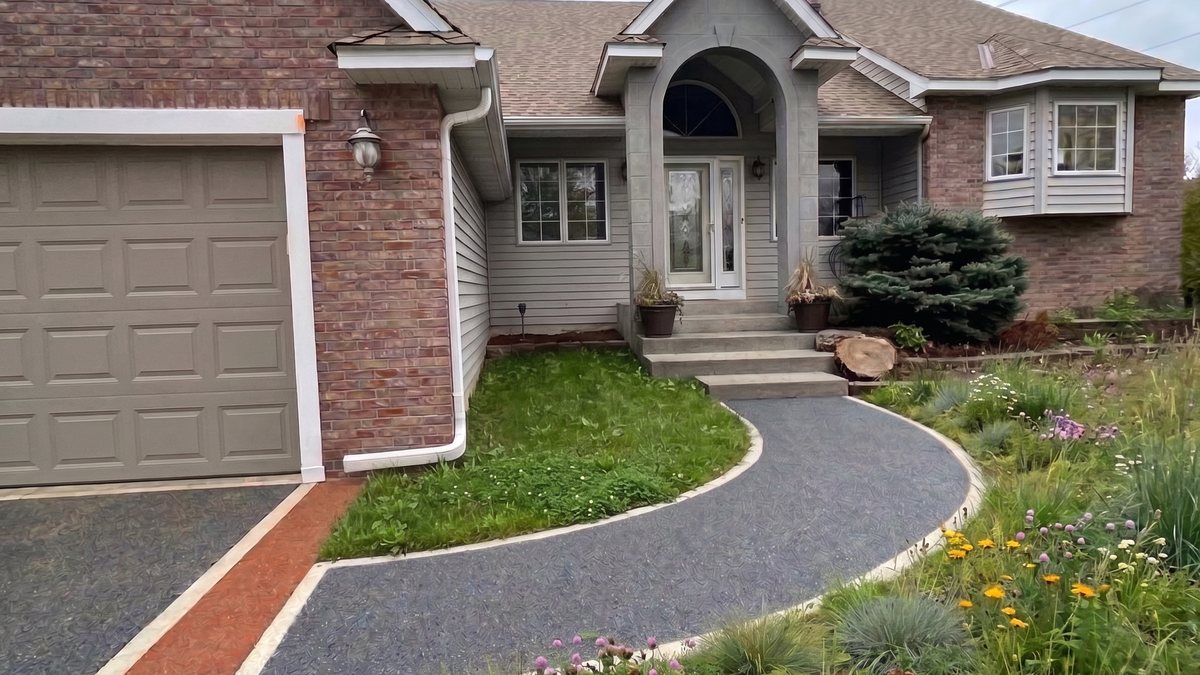
One combination is worth knowing about. AOne Materials® StonePave is a resin-bound system — natural stone aggregate bound in resin and laid joint-free over a prepared base — and it is permeable, so meltwater drains through the surface into the base below rather than running across it to the bottom of the drive and refreezing there.
With a conventional slab, meltwater has to go somewhere, and where it goes is decided by the fall of the driveway. That is often the apron, or the garage threshold, or a low spot that then ices. A permeable surface changes that question rather than answering it.
We install StonePave in the Twin Cities, with the heated option specified at design stage. One thing we will not claim is how a resin-bound surface performs over many Minnesota winters — resin-bound paving is far better established in the milder UK, and we do not yet hold cold-weather documentation from the manufacturer. When it arrives it goes on the product page whatever it says.
Is it worth it?
On a flat, short driveway in a household that does not mind clearing snow, probably not. On a steep drive, a long approach, or where clearing snow is a genuine problem for whoever lives there, it changes the winter.
The decision worth making early is not whether to heat it now, but whether the driveway you are about to build could take heat later. It cannot, unless the build-up is designed for it — so this question is worth asking before the surface goes down, not after.
Our driveways and walkways page covers the base preparation, the concrete specification and the drainage that any driveway needs, heated or not.
Common questions
What does a heated driveway cost to run?
It depends on the heated area, the system type, the zoning, the controls, your utility rate and how hard the winter is. What can be said is the shape: cost scales with area and with how long the system runs, and both are decided at design stage.
Hydronic or electric?
Hydronic generally costs more to install and less to run, and suits larger areas. Electric is simpler, needs no boiler, and suits smaller areas and walkways. Area, the heat source the house already has, and what the panel can carry decide it.
Can I add heat to my existing driveway?
No. The system sits within the build-up beneath the surface, so adding it means taking the surface up. It is a decision for the driveway you are about to build rather than the one you have.
Will it clear the ridge the plow leaves?
Not readily. Plowed snow deposited across the apron is compacted and far denser than falling snow, and a snow-melt system will take a long time with it. The heated area handles what falls on it, not what is pushed onto it.
Does it work in a power outage?
No. Both system types need power, electric directly and hydronic for the boiler and pumps. It is worth knowing before it is relied on.
Does the surface above it matter?
The heating decision and the surface choice are largely independent — the system can sit under concrete, pavers or a resin-bound surface. Where it does matter is drainage: a permeable surface takes meltwater down into the base rather than running it across to a low spot where it refreezes.
Free Estimate
Planning work like this in the Twin Cities?
Whether a heated system is worth it depends on your slope and your drive. We will come and look, at no charge, and put what we find in writing.