
Decks & Outdoor Living August 30, 2026
What Decides What a Deck Costs in Minnesota
Why we do not publish deck price ranges, and what actually moves the number — size, height above grade, footings, decking, railing and stairs.
This question rarely gets answered in writing, and homeowners reasonably read that as evasion. The reason is that what decides a deck’s cost in Minnesota depends on a handful of variables that swing the number by multiples, and a single figure quoted without them is close to meaningless.
We do not publish ranges, and that is deliberate. A number without a site visit is a guess, and a figure published on a page becomes something a homeowner holds a builder to long after it stopped being accurate. Height above grade, access and ground conditions are three of the largest drivers and none of them can be judged from a description.
So here is the useful version: what actually decides the cost, in order of impact, and what to compare between two quotes for the same deck.
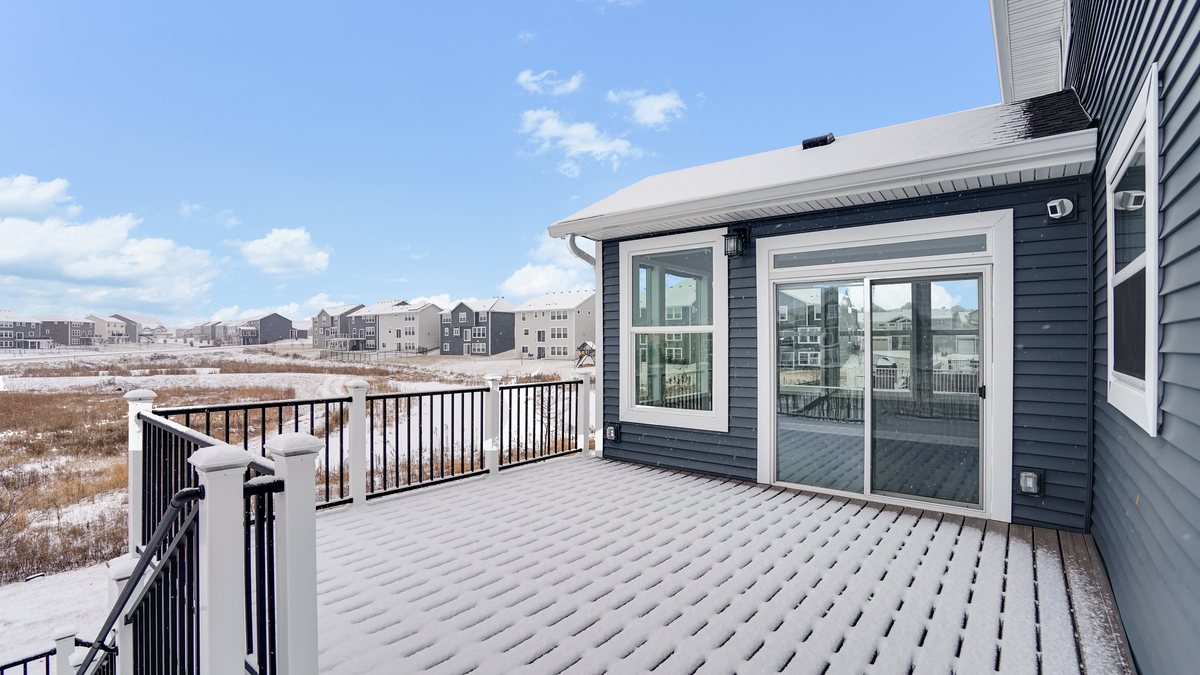
Size, and why it does not scale in a straight line
Square footage is the largest single driver, but it does not scale evenly. A deck grows in cost in steps rather than smoothly, because past a certain span the structure changes: a second beam line appears, or a mid-span post, or the joists move up a size.
That is why doubling the area does not double the price, and why a modest increase can cross a threshold and cost more than the extra square footage suggests. It is worth asking where those thresholds sit for your design before settling the dimensions.
Height above grade — the driver people underestimate
How high the deck sits changes almost everything structural. It decides post size and how many footings go in. It decides whether a guard is required at all — above roughly 30 inches, a walking surface needs one. It decides whether you need a step or a full flight of stairs with its own footings and its own guard.
A ground-level deck and a walkout-level deck of identical area are different builds at different prices. If two quotes are far apart, this is the first place to look.
Footings
Footings are set below the frost depth your city requires, which across most of the metro means 42 inches. The choice is between poured concrete piers, driven-pin systems and helical piers, and it is usually decided by the ground and the access rather than preference — getting a machine into a tight side yard on an older Minneapolis or Saint Paul street is sometimes the binding constraint.
The number of footings follows from the span and the height, which is why this line item moves with the two drivers above rather than independently.
Decking material
This is the choice homeowners spend the most time on and it is rarely the difference between two quotes.
Cedar costs less at the outset, is cooler underfoot in direct sun, and suits some houses better than a manufactured board. It wants cleaning and sealing on a schedule, and it moves more through freeze-thaw.
Composite costs more up front and is rated against rot, splitting and insect damage, with no annual sealing. Product lines differ mainly in cap thickness, color range and warranty rather than in structure — the price step between tiers buys appearance and warranty coverage, not a different kind of board.
The comparison worth making is over ten years rather than at the delivery price, because the maintenance difference is real and the sealing season here is short.
Railing — the line that surprises people
Railing is consistently the item homeowners underestimate. On a small deck a premium railing system can approach the cost of the decking itself.
The range runs from pressure-treated wood at the bottom, through powder-coated aluminum in the middle, to cable and glass at the top. All meet the same requirement — typically 36 inches high with baluster spacing that will not pass a 4-inch sphere, confirmed by your city at plan review — so this is largely an aesthetic choice with a wide price range attached to it.
Stairs and landings
A flight of stairs is a line item rather than a detail. It carries its own framing, its own footings below frost depth, and its own guard. Landings need footings too, which is the part people are surprised by.
A deck that needs one step and a deck that needs a full flight to grade are meaningfully different projects.
What to compare between two quotes
If one quote on the same deck comes in well under another, the difference is rarely in the boards. Compare these line by line:
- The number and depth of the footings
- Framing sizes, spans and the number of posts
- The railing system and its height
- Whether stairs and landings are included
- How the ledger connection, flashing and joist protection are specified
- Whether permit fees are in or out
None of those is visible in a finished photograph. Comparing quotes usefully means comparing what is in them line by line, not comparing totals.
What we do not charge extra for
Permit fees are included in a Stonevale project rather than billed separately. The site visit, the measurements and the written scope are free and carry no obligation.
Structural engineering, where a design calls for it, is quoted separately rather than folded in — that keeps the base price to the work most decks need.
Getting to a number you can rely on
The only way to a figure you can rely on is a site visit.
Our deck building and outdoor living page sets out the construction detail behind each of these drivers — footings, framing, the ledger connection and under-deck drainage. If the grade turns out to be close to the house, a paver or concrete patio costs less, needs no guard, and is worth pricing alongside.
Common questions
Why will you not publish a price range?
Because a range without a site visit is a guess dressed as information. Height above grade, access and ground conditions are three of the largest drivers and none can be judged from a description. A number that is wrong is worse than no number, and a published figure becomes something a homeowner holds a builder to long after it stopped being accurate.
What is the single biggest driver?
Size, then height above grade. Both change the structure rather than the finish, which is why they move the number more than any material choice.
Does composite cost much more than cedar?
At the outset, yes. Over ten years the gap narrows, because cedar wants cleaning and sealing on a schedule. The structure underneath is treated lumber either way and costs the same.
Why is railing so expensive?
Because it is a structural element with a finish attached. It carries load, it has to meet the guard requirement, and the range from pressure-treated wood to cable or glass is wide. On a small deck a premium system can approach the cost of the decking.
Are permit fees included?
In a Stonevale project, yes, rather than billed separately afterwards. Structural engineering, where a design calls for it, is quoted separately so the base price covers the work most decks need.
How do I compare two quotes fairly?
Line by line, not by total. Compare the number and depth of footings, the framing sizes and spans, the railing system, whether stairs are included, and whether permit fees are in or out. None of that is visible in a finished photograph.
Free Estimate
Planning work like this in the Twin Cities?
The only way to turn those variables into a number is to stand in the yard. That visit costs nothing, and the written scope that follows is yours whatever you decide.